
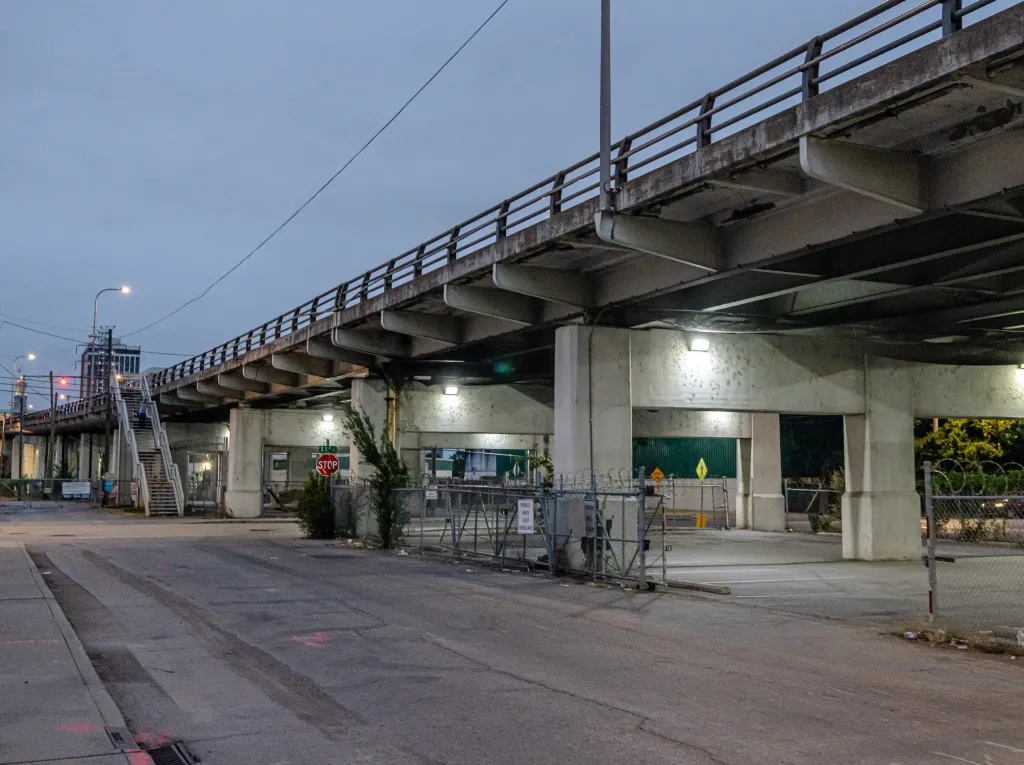
Drivers crossing the Cumberland River near downtown Nashville will lose a major route for two years when the James Robertson Parkway/Victory Memorial Bridge closes in summer 2027, a shutdown that will overlap with the opening year of the new Nissan Stadium.
The Tennessee Department of Transportation announced the closure Thursday as part of a project to reshape the connection between downtown and the East Bank. Construction is scheduled to begin in spring 2027, before the bridge closes during the summer.
Crews will lower the bridge approach and connect James Robertson Parkway to East Bank Boulevard. Plans also call for signalized intersections, utility upgrades and expanded roadway capacity. The changes are intended to turn an elevated approach into a connection with the East Bank’s developing street network.
Once the closure begins, motorists will need to use one of the other three bridges across the Cumberland in or near downtown. The two-year interruption will change travel patterns for commuters, downtown workers, East Nashville residents and people attending events along the river.
“Redesigning James Robertson Parkway is part of our citywide vision for infrastructure that makes it easier for all of us to move around,” Mayor Freddie O’Connell said in a release. “It means a safer road, an efficient connection from East Nashville to downtown, and a street grid for the East Bank where a giant concrete wall once stood.”
The project is part of a larger effort to reconnect an area long shaped by industrial uses, major roads and stadium parking. Although the East Bank sits directly across the river from downtown, its large blocks and transportation barriers have made some nearby destinations less directly accessible than their distance would suggest.
Metro’s Imagine East Bank planning effort established a framework for redevelopment that emphasizes a connected street grid, transportation options and access to the river. East Bank Boulevard is a central element of that framework. Connecting the parkway to the boulevard is meant to make the surrounding streets function as a network rather than as isolated approaches to individual destinations.
For residents, the immediate consequence will be disruption before those longer-term connections are available. Because construction starts before the bridge closes, travelers should monitor project notices beginning in the spring rather than waiting for the summer shutdown. Regular commuters may need to reconsider their routes, while businesses that rely on deliveries across the river should account for the closure in their planning.
TDOT’s website, tn.gov/tdot, provides access to agency project information and public contact channels. Its SmartWay service offers highway traffic conditions and cameras that can help drivers assess congestion on surrounding state routes. Event visitors should also review venue transportation instructions before leaving home, particularly as construction changes access to the East Bank.
The bridge work comes as the new Nissan Stadium approaches its scheduled completion. The translucent roof is in place, and some seats have been installed on the lower level.
Construction is scheduled to conclude in February 2027, with the first events planned for the spring. The stadium will become the Tennessee Titans’ new home and is set to host Super Bowl LXIV on Feb. 10, 2030.
The Titans have played on the East Bank since their current stadium opened in 1999. The new enclosed venue represents another major change for the riverfront, with the ability to accommodate events under a roof rather than in an open-air stadium.
The construction schedules place the new stadium’s opening season in the same year as the bridge shutdown. That overlap makes transportation planning important not only for football fans but also for residents whose everyday routes pass through the area. A completed stadium will not mean the surrounding road work is finished.
Separately, Vanderbilt University faces a second proposed class action over a data breach and cyberattack attributed to the hacker group BYOD. A second group of plaintiffs filed suit Nov. 11, following an initial lawsuit filed Nov. 9, the day the attack occurred.
“[Vanderbilt] failed to implement practices and systems to mitigate the risks posed by its negligent (if not reckless) IT practices,” the complaint states. Those assertions are allegations, not court findings. A class-action filing does not itself establish liability or mean a court has approved a case to proceed on behalf of a broader group.
BYOD has claimed credit for 15 to 20 attacks since September. In a statement defending its actions, the group wrote: “We have morals and we have a heart, we are not villains, but we will still continue to hold companies responsible for bad security leading to the compromise of any customer data.”
“That’s the whole reason why we came about and we plan to keep it that way,” the group wrote. Its characterization of its motives does not establish the scope of the breach or resolve the claims against Vanderbilt.