
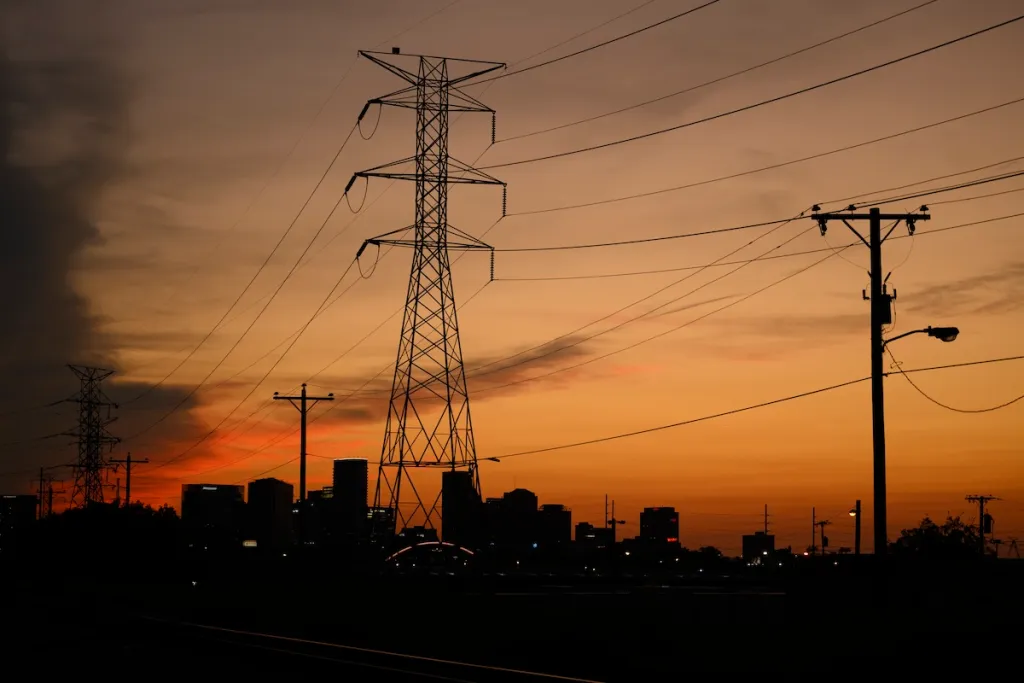
The Tennessee Valley Authority plans to add about 2.5 gigawatts of electrical capacity through a $581 million regional grid improvement effort backed by $250 million in federal funding, the U.S. Department of Energy announced Wednesday, Oct. 14.
The plan encompasses 84 projects, including improvements to roughly 125 miles of existing transmission lines across Tennessee, Alabama and North Carolina. The Energy Department said the work is intended to reduce power outages, increase the amount of electricity the grid can accommodate and ease consumer energy costs.
For Nashville residents, the investment involves the regional network that supplies power to their local utility. TVA provides wholesale electricity to Nashville Electric Service, which distributes it to homes and businesses in Davidson County and parts of surrounding counties.
Transmission lines carry large amounts of electricity across the region, linking power plants and other energy resources with substations. Local utilities then deliver that electricity to individual customers through distribution lines. Improvements to the transmission network can therefore matter to Nashville even when construction occurs outside the city.
“America’s electric grid cannot become a roadblock to economic growth,” Katie Jereza, an assistant secretary at the Energy Department, said in the announcement. “By bringing TVA and local utilities together, we’re helping reduce costly outages and deliver more power where it’s needed. That means fewer disruptions for families, more opportunities for businesses, and a stronger foundation for American jobs.”
The federal award represents about 43 percent of the overall project budget. The work on existing transmission lines makes upgrading infrastructure a central part of the plan, alongside the announced capacity expansion.
About 2.5 gigawatts is equivalent to 2,500 megawatts. Capacity describes how much power a system can generate or carry at a given time; it is different from the amount of energy customers consume over a month. Increasing grid capacity helps move electricity to the places that need it, but does not by itself mean a corresponding amount of new power generation is being built.
TVA was established by Congress in 1933 as part of the New Deal, with a mission that included flood control, navigation, electricity production and economic development in the Tennessee Valley. Today, the federally owned utility supplies electricity through local power companies across a seven-state region.
That structure separates TVA’s wholesale role from the responsibilities of utilities such as NES. TVA operates the broader power system, while NES handles local electric service, customer billing and repairs to its distribution network. A regional transmission project is consequently different from a neighborhood effort to replace utility poles or restore lines damaged by a fallen tree.
The investment comes as Middle Tennessee’s long-term population and business growth place continuing demands on infrastructure. New housing, commercial development and industrial operations all require electricity, while heating and cooling needs can drive sharp increases in demand during extreme temperatures.
The importance of regional power reliability became especially clear during the December 2022 winter storm, when TVA directed local utilities to implement rotating outages amid extreme cold and problems with power generation. Transmission upgrades address one part of the reliability challenge; maintaining adequate generation and preparing local distribution systems for severe weather remain separate needs.
For customers, the distinction matters. A stronger regional grid can reduce the risk of some disruptions, but it cannot prevent every outage caused by storms, damaged equipment or problems on neighborhood lines.
The Energy Department’s statement about easing consumer costs also describes a goal, not an announced reduction in electric rates. Customers’ bills reflect both the amount of electricity they use and the applicable charges. The federal funding contribution should not be read as a direct household rebate or a promised monthly savings amount.
As the projects move toward construction and completion, their significance for individual communities will depend on the facilities involved and how the improvements fit into the interconnected network. The announced transmission work spans three states, underscoring that the intended benefits extend beyond any single city or utility service area.
Residents can follow TVA’s transmission project information through tva.com, where the utility posts project-specific notices and public involvement information. Nashville customers should continue to contact NES for billing questions, local service issues and outage reports; customer service and outage information are available at nespower.com. Those local reporting channels remain important even as the regional grid receives new investment.