
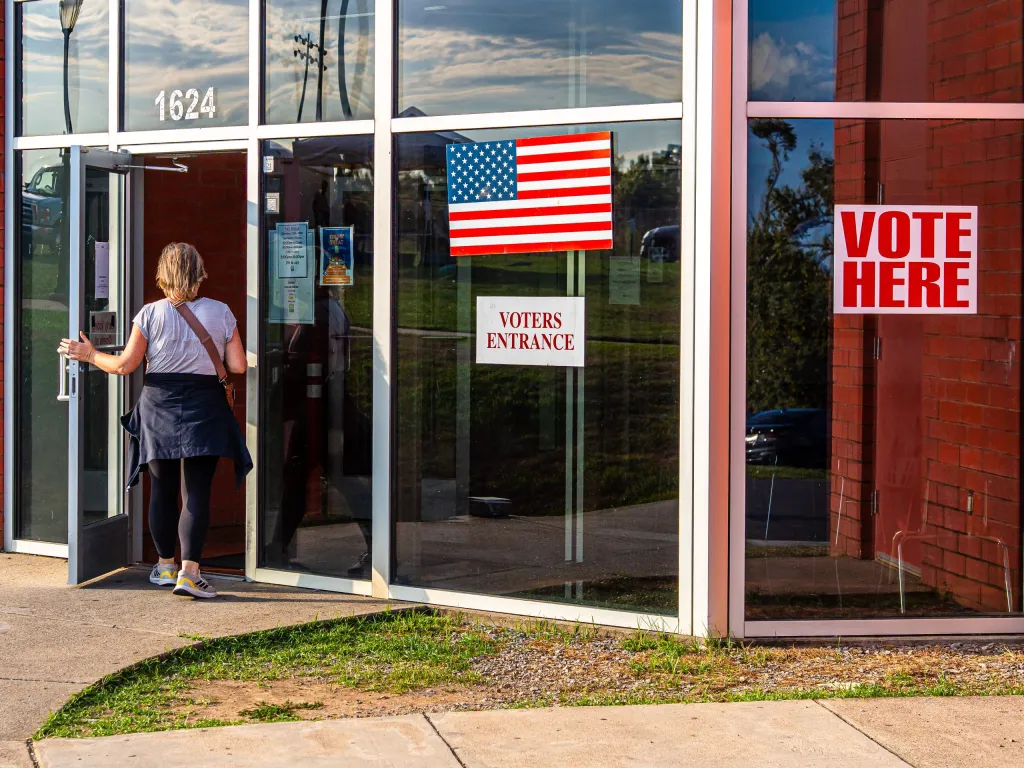
Davidson County voters cast 8,393 ballots Wednesday as early voting opened for the Nov. 3 general election, beginning a period in which residents can vote ahead of Election Day at locations throughout the county.
The Davidson County Election Commission reported that participation across 15 early voting sites amounted to 1.74 percent of the county’s registered voters, or close to 2 percent. Bellevue Library recorded the busiest opening day, with 1,027 voters. Hermitage Library followed with 999, and Edmondson Pike Library recorded 962.
Opening-day turnout was below the 13,986 ballots cast on the first day of early voting in 2024. That comparison spans different election cycles: The 2024 election included a presidential contest, which typically attracts greater participation than a midterm election.
Early voting continues Thursday, Oct. 15, from 8 a.m. to 7 p.m. The early voting period runs through Oct. 29, excluding Sundays.
For Davidson County voters, early voting offers flexibility that is not available on Election Day. Registered voters may use any early voting location in their county, rather than going to their assigned neighborhood precinct. On Election Day, voters generally must cast their ballots at their designated polling place.
Residents should check the Davidson County Election Commission’s pages at nashville.gov for the full schedule, addresses and sample ballots before traveling. Tennessee’s GoVoteTN voter information service also provides registration and polling information. Checking a sample ballot ahead of time can help voters prepare for state and local contests and referendum questions.
Tennessee generally requires voters casting ballots in person to present a qualifying photo ID issued by the state or federal government, subject to statutory exceptions. The Tennessee secretary of state’s election website explains accepted identification and procedures for voters who arrive without it.
Court ruling in Fairgrounds dispute
A separate development involving the debate over the Nashville Fairgrounds came in Davidson County General Sessions Court, where Judge Allegra Walker dissolved a temporary order of protection against Kevin Wisniewski.
Wisniewski, a former local television producer, works for Calvert Street Group, a public affairs firm representing interests that support racing at the Fairgrounds Speedway.
William Lee Pardue and Alexander Mott obtained the temporary order in August 2026 after accusing Wisniewski of stalking. Both are members of Citizens Against Racetrack Expansion, known as CARE.
Walker ruled “that the petitioner knew that the allegation of stalking was false at the time the petition was filed.” She also ordered Pardue and Mott to pay Wisniewski’s legal fees. Attorney Daniel Horwitz represented Wisniewski. Horwitz also represents the Nashville Banner, which reported the ruling.
CARE supports a ballot referendum that would change the required uses of the fairgrounds, replacing “auto racing” with “affordable and/or workforce housing.” The protection-order case concerned the stalking allegations, rather than the merits of that proposed change.
The fairgrounds, south of downtown near the Wedgewood-Houston neighborhood, has long accommodated racing, a flea market and exhibition activities. Its speedway has a history stretching back more than a century and has hosted NASCAR competition. The broader campus also includes GEODIS Park, home to Nashville SC.
Debates over the property bring together questions about preserving longstanding public uses, managing noise and traffic, and meeting housing needs as Nashville grows. The Metro Charter protects specified fairgrounds activities, making the wording of those requirements important to future decisions about the publicly owned property.
Changing a required use would not itself build housing. Development would still involve separate planning, financing and public decisions.
Governor’s race allegation
In the Tennessee governor’s race, a signed affidavit from 1998 alleges that candidate David Hatley threatened to kill a woman if she exposed financial misconduct involving his hot tub business.
The affidavit accuses Hatley of collecting down payments as a hot tub salesman, failing to perform the promised work and closing the business. The alleged threat was described as an effort to prevent one woman from revealing the scheme.
Republican gubernatorial frontrunner Marsha Blackburn’s campaign distributed the document to reporters and posted the allegations on deadbeatdave.com, a campaign attack website targeting Hatley.
Hatley is running as a conservative independent after failing to qualify for the Republican ballot. He was convicted of felony bank fraud around the same period as the affidavit, in a case connected to the hot tub business. The death-threat allegation is distinct from that conviction; an accusation in an affidavit is not itself a finding of guilt.
Hatley’s campaign did not respond to multiple requests for comment Wednesday.