
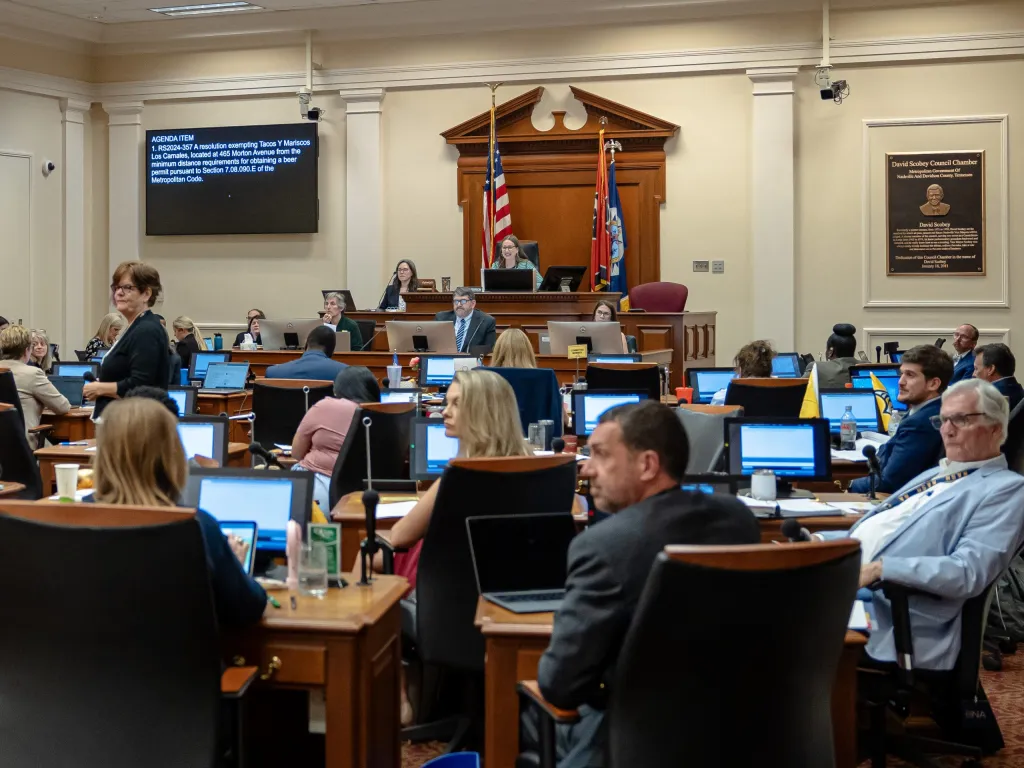
Nashville’s next council election is becoming the focal point of a much larger decision about how residents will be represented, as Metro officials work to carry out a court-backed requirement to cut the council’s membership by at least half.
The Tennessee Supreme Court ruled last week that the 40-member Metro Council must comply with a state limit of no more than 20 members. The immediate challenge is determining whether that smaller body must be elected in August 2027 or whether voters can approve a transition that takes effect later.
The council’s Charter Revision Committee is scheduled to meet Friday evening, Nov. 13, with Metro Legal Director Tyler Yarbro. Its work comes as councilmembers begin seeking public input on both the transition and the structure of a smaller legislative body.
For residents, the stakes extend beyond the number of elected officials. Decisions about district boundaries and countywide seats will shape whom voters can elect, which communities share a representative and how candidates compete for office.
A central procedural issue is the relationship between Metro’s charter and the state law requiring the reduction. The charter calls for amendments to go before voters at regularly scheduled elections. Without a specially called election, the next opportunity for a referendum is August 2027—the same election in which council seats will be on the ballot.
Putting a charter change before voters then could push implementation to a later council term, potentially 2031. A special election before August could offer another route, but it would run against the charter’s regular-election requirement.
The state law gives the council authority to take necessary legislative action by resolution, with a majority of members present and voting, despite conflicting charter provisions. Whether and how Metro should use that authority is part of the implementation debate.
At Monday’s Minority Caucus meeting, Councilmember Jeff Preptit argued that the required restructuring should go through the charter revision process and reach voters. He and Councilmember Kyonzté Toombs also discussed the possibility of working with the Tennessee attorney general on a transition plan.
State officials, however, are pressing Metro to proceed. Kaki Carrigan, spokesperson for Attorney General Jonathan Skrmetti, said state law gives the council both the responsibility and the power to implement a 20-member body.
Carrigan pointed to the original 2023 legislation, which contained deadlines and a provision allowing council terms to be extended by a year to accommodate the change. She said implementation provisions were removed after Metro challenged their constitutionality, while appellate courts upheld the membership cap.
Further lower-court proceedings will help shape the transition. Meanwhile, the General Assembly’s return in January adds another potential point of conflict between Metro and state officials over the pace of the reduction.
The makeup of the new council presents a separate set of choices. Members could retain a mix of district and at-large seats, adopt an entirely district-based system or consider regional seats covering larger areas. The cap also leaves open whether Nashville should have 20 councilmembers or fewer.
Minority representation has become a central concern. Metro Human Relations Commission Executive Director Davie Tucker urged the Minority Caucus to support 20 district seats and eliminate at-large positions. Caucus members did not reach agreement on the best structure.
That debate has roots in Metro’s creation. When voters approved city-county consolidation in 1962, some Black community leaders feared it would weaken their political influence. The five at-large seats were viewed as a means of protecting white political control.
Nashville’s more recent elections illustrate how those dynamics have changed. Black women Zulfat Suara and Delishia Porterfield finished first and second in the latest competition for at-large seats. Their success complicates any assumption that countywide elections necessarily prevent minority candidates from winning.
Councilmembers are also considering whether a smaller body should have full-time positions, higher compensation or additional staff, and whether an internally elected council president should replace the vice mayor.
Public participation will be part of the next stage. Councilmember Erin Evans is polling constituents, and hearings in different parts of Davidson County are expected. Those discussions will give residents an opportunity to weigh in on a restructuring that could change both their election choices and their access to local government.