
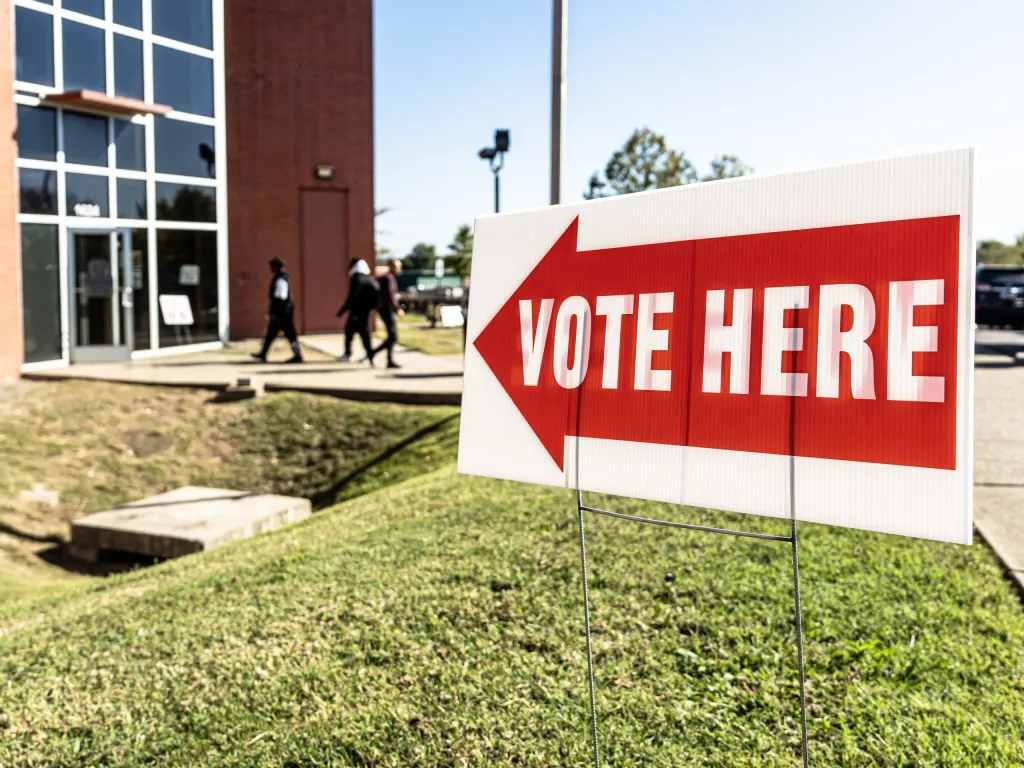
Nearly 19,000 Davidson County voters cast ballots during the first two days of early voting for the Nov. 3 general election, with participation increasing on the second day.
The Davidson County Election Commission counted 10,330 voters Thursday across the county’s 15 early voting sites. The cumulative total reached 18,723, representing 3.88 percent of registered voters.
Early voting continues through Oct. 29, excluding Sundays. Polling hours are 8 a.m. to 5:30 p.m. Friday, Oct. 16, and 8 a.m. to 4:30 p.m. Saturday, Oct. 17.
Tennessee allows registered voters to vote early in person without giving a reason. Davidson County voters can use any early voting location in the county, rather than being limited to their assigned Election Day precinct. That flexibility can help residents fit voting around work schedules, caregiving and transportation needs.
Voters should check the Davidson County Election Commission’s page on Nashville.gov for locations, the full schedule and sample ballots before making a trip. Tennessee generally requires voters to present an acceptable photo ID issued by the state or federal government, with certain legal exceptions. The Tennessee secretary of state’s GoVoteTN service also provides election information.
The first two days’ figures offer an initial measure of participation, not a final turnout picture. Additional in-person early votes, absentee ballots and Election Day voting will contribute to the eventual total.
Neighborhoods also have an opportunity to prepare their streets for another date on the October calendar: Halloween. Through Open Streets Nashville, residents can apply for a block party permit to close a neighborhood street for trick-or-treating. There is no application fee for a neighborhood open street.
The program was created by the Nashville Department of Transportation and Multimodal Infrastructure and Walk Bike Nashville, a local organization that advocates for walking and bicycling.
“Street safety is a priority every day and Halloween night is no different,” NDOT Director Ryan Lynch said. “Opening streets for people is a great tool for neighborhoods looking to celebrate.”
Temporary street closures can give families more space to walk and gather while reducing conflicts with vehicles within the permitted area. They do not eliminate the need for care at intersections or on surrounding streets.
Residents interested in organizing a closure can consult NDOT’s Open Streets Nashville information through Nashville.gov for application instructions and requirements. Organizers should coordinate with neighbors and review access and safety requirements before finalizing plans; applying for a permit is not the same as receiving approval.
On the economic front, Tennessee’s September unemployment rate stayed at 3.4 percent, matching July and August, according to figures released Thursday by state labor officials. During the first half of the year, the rate was either 3.5 or 3.6 percent.
September’s rate was below both its September 2025 level of 3.5 percent and the national September rate of 4.2 percent.
Tennessee added 2,500 nonfarm jobs in September. Job growth totaled 28,400 from October 2025 through September 2026, with the largest gains in leisure and hospitality, healthcare, social assistance and state government.
Average hourly earnings for Tennessee workers rose to $25.79 in September from $25.31 in August. Despite that increase, the state average remained below the national figure of $30.19.
The unemployment rate measures people without jobs who are actively seeking work as a share of the labor force. It does not capture everyone outside the workforce or show whether employed residents have enough hours or earnings to meet household expenses. Statewide figures also do not necessarily reflect conditions in individual Nashville neighborhoods.
A newly available interactive map offers another Tennessee connection, documenting 592 surviving structures from the Rosenwald school program. More than 500 buildings remain today, including a dozen in Tennessee and one in Nashville. The database provides images, locations, historical accounts and other resources about the schools and their communities.
Jewish philanthropist Julius Rosenwald and Black educator Booker T. Washington launched the school-building program in 1912 to expand educational access in the rural South. Over the next 20 years, the effort produced 5,357 schools, teachers’ homes and shop buildings across 15 Southern states, serving more than 600,000 children who received little or no education.
The program developed during segregation, when public funding for Black education was deeply unequal. Black communities contributed money, land and labor to help establish the schools, making the buildings symbols of local commitment as well as educational opportunity.
For Nashville residents, the database offers a way to connect a surviving local building to that broader Southern history. Its community histories can also help families, educators and preservation advocates explore the people and places behind the school-building effort.