
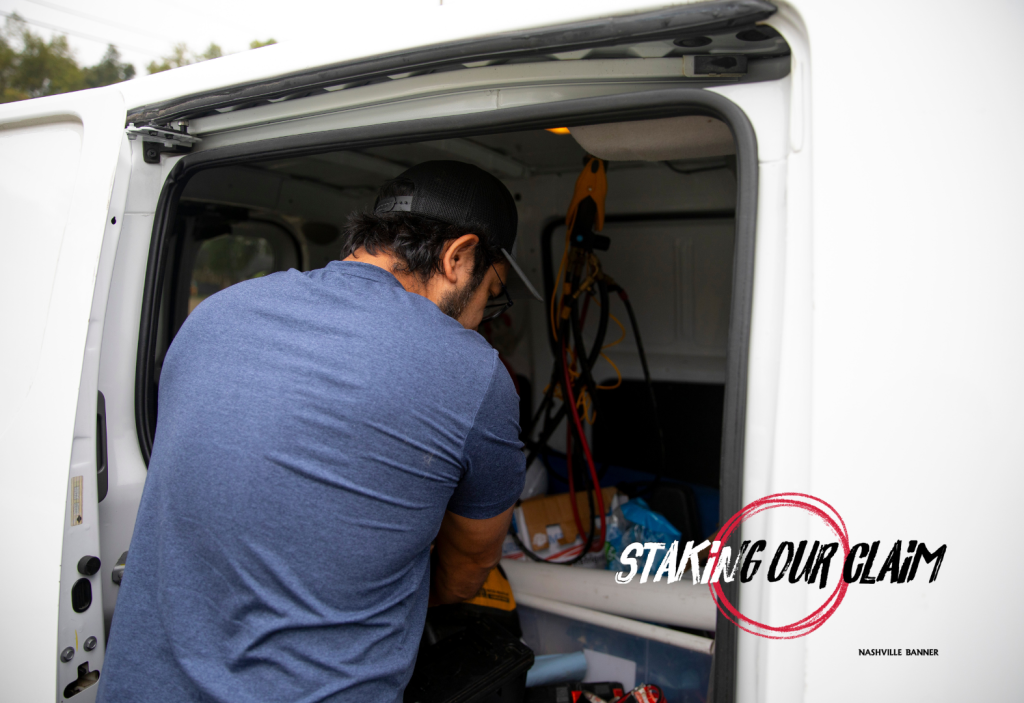
Eight years after applying for asylum, a Nashville HVAC technician is still waiting for a decision that could help resolve a central uncertainty in the life he has built for his family.
The worker, identified as Miguel at his request to use a pseudonym, fled violence in Venezuela. He loves living in Nashville and has established a life here. But the prolonged wait has left him wondering how much longer he will remain in legal limbo, despite his efforts to follow the required process.
During the peak of summer, Miguel works seven days a week, sometimes 14 hours a day or more. He does it to provide a good life for his family. His job helping people feel comfortable in their homes stands in contrast to the uncertainty surrounding his own sense of home.
His experience is the subject of “Working Overtime,” the second episode of the Nashville Banner’s “Staking Our Claim” podcast. The episode brings together two parts of life that can be discussed separately: the work that sustains a growing city and the immigration proceedings that shape whether some of its residents can confidently plan their futures.
In Nashville, heating, ventilation and air-conditioning work is essential to daily life. The city’s hot, humid summers place heavy demands on cooling equipment. When systems break down, indoor conditions can become uncomfortable and, especially for older adults and people with certain medical conditions, dangerous.
HVAC technicians install, maintain and repair the equipment that regulates indoor temperatures. Their work can involve outdoor units, cramped crawl spaces and hot attics. Summer service calls often arrive precisely when temperatures make the work most difficult. Miguel’s long days reflect the demands of keeping households comfortable during that busiest season.
Nashville’s growth also gives that work a broader significance. Years of residential and commercial development have added buildings that need cooling systems, maintenance and repairs. Older homes need continuing service as well. The trades supporting that infrastructure are part of the everyday labor behind the city’s expansion, even when residents encounter those workers only during an emergency repair.
For Miguel, steady effort has not brought a corresponding resolution to his immigration case. His eight-year wait illustrates an important distinction: building a home, supporting a family and participating in a community do not, by themselves, settle an asylum application.
Asylum is a form of protection under federal law for people who meet specific requirements. Generally, an applicant must establish past persecution or a well-founded fear of persecution connected to race, religion, nationality, political opinion or membership in a particular social group. Fleeing violence can be part of an applicant’s experience, but the legal determination depends on the individual circumstances and the applicable law.
Applications can proceed through different parts of the federal immigration system. U.S. Citizenship and Immigration Services handles affirmative asylum applications within its jurisdiction. Immigration judges in the Justice Department’s Executive Office for Immigration Review consider asylum requests in removal proceedings. The route a case takes affects its procedures and how an applicant checks its progress.
Both the asylum system and immigration courts have faced substantial backlogs. A pending application can require years of waiting, with timing affected by workload, scheduling, case history and other factors. A long delay is not itself a decision about whether a person qualifies for protection.
Work authorization is a separate matter. Federal rules allow some people with pending asylum applications to seek employment authorization after meeting applicable waiting periods and other requirements. Permission to work does not amount to a grant of asylum, and a pending application is not the same as permanent residence or citizenship.
Those distinctions matter beyond the courtroom. An unresolved case can complicate decisions about travel, education, housing and family plans. Immigration requirements can also involve maintaining current contact information, responding to notices and appearing for scheduled proceedings. Applicants should obtain guidance specific to their cases rather than assume that another person’s experience will match their own.
Miguel’s departure from Venezuela fits within a much larger displacement from that country. Political turmoil, economic collapse, insecurity and human rights abuses have driven millions of Venezuelans abroad over the past decade. Many have settled elsewhere in Latin America and the Caribbean; others have sought protection in the United States.
That regional history provides context, not an automatic answer to any individual asylum claim. U.S. officials evaluate applications under legal standards that require more than a general account of conditions in a person’s home country. For families waiting on a decision, the difference between a national crisis and the evidence required in an individual case can be consequential.
Nashville, meanwhile, has become home to immigrant and refugee communities from many parts of the world. Its Kurdish community is among the most established and visible examples. Along Nolensville Pike and elsewhere, immigrant-owned businesses, religious institutions and community organizations have helped reshape the city’s commercial and cultural life.
The terms used to describe those residents are not interchangeable. Refugees generally receive approval for resettlement before entering the United States, while asylum seekers request protection after arriving or at a port of entry. Other immigrants come through family, employment or additional legal pathways. Their experiences may overlap, but their rights, procedures and timelines can differ substantially.
For Nashville residents with questions about an asylum case, the responsible agencies are federal, not Metro Nashville government. USCIS provides case information and contact options at uscis.gov. Its online tools include case-status checks for eligible receipt numbers and instructions for updating an address. Immigration court information is available through justice.gov/eoir, including access to the agency’s case-information system.
People seeking legal help can consult the Justice Department’s roster of recognized organizations and accredited representatives or seek a licensed immigration attorney. The Tennessee Immigrant and Refugee Rights Coalition, based in Nashville, is another point of contact for community information and referrals. Applicants should confirm available services directly and avoid anyone who guarantees an outcome.
“Working Overtime” is hosted by Kashif Andrew Graham, produced by Steve Haruch and edited by Andrea Tudhope, with theme music by S-Wrap. Listeners can follow “Staking Our Claim” by subscribing to the Banner & Company feed on Spotify, Apple Podcasts, YouTube, Amazon or iHeart Radio.
Tudhope is the Banner’s managing editor and leads community engagement and its audio work. She previously spent a decade in public radio as a reporter, newscaster and editor. As a founding team member of America Amplified, a public media community engagement initiative, she launched a national talk show and co-wrote and edited a community-powered journalism playbook. She came to Nashville to launch WPLN’s “This Is Nashville,” serving as executive producer for two years. She can be reached at andrea@nashvillepublicmedia.com.
Haruch, the Banner’s senior producer, is an award-winning journalist, editor and producer who previously worked at the Nashville Scene and WPLN. His writing has appeared in The New York Times and NPR’s Code Switch. He edited “Greetings From New Nashville: How a Sleepy Southern Town Became ‘It’ City” and “People Only Die of Love in Movies: Film Writing by Jim Ridley.” His email is sharuch@nashvillepublicmedia.com.
For Miguel, the immediate reality remains work, family and waiting. He has made Nashville his home and says he has followed the required process. Eight years into that process, he is still waiting for the decision that could make his future here less uncertain.